

The Source Canada Newsletter, Monday August 10, 2026
Alex McIsaac from Northside Ventures published an excellent article this week, Where is the White Space for Canadian Defence Founders?
Northside is a pre-seed fund investing in Canadian founders throughout North America. Their defence portfolio includes missile startup North Vector Dynamics and Canada Rocket Company, which is building Canada's sovereign space launch capacity.
Alex takes a different approach from the BDC/Icebreaker survey published in June. Using a bottom-up approach he maps truly early-stage Canadian defence startups against the DIS' 10 sovereign capabilities.
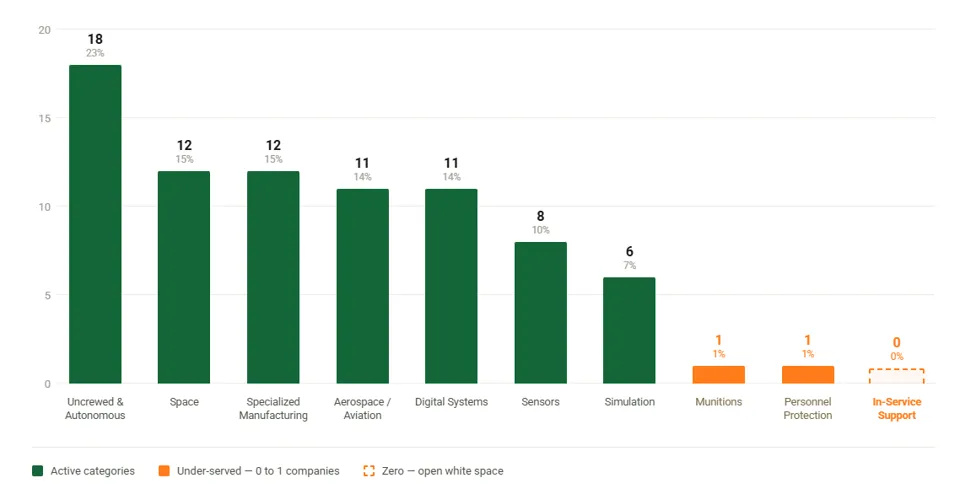
This matches what we are reading in today's defence news headlines. UAS dominates while there are few companies in, for example, munitions. Perhaps Canada's emerging nitrocellulose startups will change that. Other overlooked areas are personnel protection (medical countermeasures) and in-service support. These are what he defines as the “open white space.”
It's a worthwhile read especially for early-stage founders.
Expanding on the article I have three additional takeaways:
- We need to create more defence startups. It's probably premature to declare white spaces considering how few Canadian defence startups exist. It makes sense that most entrepreneurs are on the sidelines considering the frozen state of defence-industrial policy over the decades. There are many defence-adjacent companies still waiting for the right conditions. Clearer demand signals and faster timelines (the Drone Defence Initiative for example) are steps in the right direction. Without more company creation at the bottom there will be no future defence winners to pick from the top.
- We need more VCs. Besides Northside, One9 and BDC there are practically no Canadian defence investors. That may be changing, with funds like Deloitte Ventures, OMERS Ventures and Georgian making their first defence investments. They will likely never be pure-play defence investors but we need their capital. VCs are waiting for the right conditions too.
- We need more non-VC capital, ideally not all from government. What would it take to activate Canadian banks or pension funds? Today's article in the Globe (Banks look to lend to defence companies, but many lack the track record to qualify) is anything but optimistic. According to Isabelle Hudon CEO of BDC, “banks are looking at different roadblocks and they are wondering how to lift those roadblocks.”
Canada's surge in defence spending needs more of the essential players (entrepreneurs, banks, VCs, pension funds) to decide the right conditions exist to get involved now. This will be one of the key themes we will be discussing at Source Canada October 22.

Deals
Telesat and MDA Space tapped for $2.3-billion Arctic satellite buildout. Ottawa awarded Telesat a $2.3B contract for military satellite communications over the Arctic, expanding the Lightspeed low-Earth-orbit constellation from 156 to 225 satellites. True North | BetaKit
Toronto's Taalas sells to AMD. AMD has signed a definitive agreement to acquire the Toronto chip company, founded in 2023 by former AMD and Tenstorrent leaders, which had raised roughly US$219 million. The Logic
Calogy secures $1.2-million contract to power Jaunt's autonomous drones. Sherbrooke thermal-management startup Calogy Solutions will design the battery system for Jaunt Air Mobility Canada's hybrid-electric VTOL drones, which are built for both defence and commercial buyers. BetaKit
Mode40 and CME launch AeroTrace across the Prairies. The program puts AI, traceability and digital-thread systems into nine aerospace, aviation and defence manufacturers, three each in Manitoba, Saskatchewan and Alberta, with costs split three ways. Findings roll up into an industry white paper. BetaKit
Counter Signal
Canada could soon lose reliable rides to space. SpaceX has stopped taking new commercial rideshare bookings beyond late 2028, favouring Starlink and orbital data-centre payloads. 2026 was tracking as a record year for Canadian payloads, nearly all of it on SpaceX capacity. Wyvern and others are now designing satellites to fit domestic launch vehicles from NordSpace and Reaction Dynamics. BetaKit
Capital
North Vector Dynamics takes a strategic investment from CSG. The Calgary-based, Canadian-owned defence technology company took an undisclosed investment from Euronext Amsterdam-listed CSG N.V. NVD says its valuation now exceeds US$90 million, with IP, design and engineering retained in Canada. True North
Canadian VC deployment rises for the first time early in a year since 2021. CVCA's H1 2026 report shows dollars deployed up, driven by a handful of very large financings. Deal count did not follow. BetaKit
White Star Capital closes a US$250-million fund. One of the few Canadian-founded venture platforms still closing a quarter-billion-dollar fund in a slower market. The Logic
Radical Ventures backs a new AI science startup from Google researchers. The Toronto fund is co-leading one of the year's highest-profile AI launches. The Logic
Defence
McGuinty launches Canada's first Quantum Defence Innovation Secure Hub. A University of Calgary-led consortium of 13 organizations, including Lockheed Martin Canada, General Dynamics Mission Systems-Canada, CAE and Calian, receives $20.3 million over two years under the BOREALIS program. The hub has a named transition path into Canadian Armed Forces and CSE capability. True North | DND
Volatus partners with Kraus Hamdani for sovereign persistent ISR. Volatus Aerospace (TSX: FLT) will bring the K1000ULE ultra-long-endurance autonomous aircraft and the ATNE++ airborne communications architecture into a Canadian-operated persistent intelligence capability. True North
Policy
Canada's defence bank has an incomplete mission. Andreas Urbanski on the Defence, Security and Resilience Bank: eight allied founding members, roughly $190B in capital, headquartered in Canada and using the BDC playbook to crowd in private capital. His argument is that cheap credit alone will not produce scale-ups without demand certainty. Globe and Mail
The FCC's foreign robot rule has Canadian tech leaders worried. The FCC added foreign-produced advanced robotic devices and connected power inverters to its Covered List, blocking new models from US authorization for import, marketing or sale. The action targets Chinese systems but is written broadly enough to catch robots built elsewhere. Previously authorized models are not affected. The Logic
Subscribe to Source Canada for weekly coverage of Canadian procurement, defence and sovereign technology. sourcecan.ca
Attend Source Canada 2026. Early bird tickets now on sale.