

The Source Canada Newsletter, Monday June 22, 2026
Ali Asaria, founder of Well.ca, Tulip and recently Transformer Lab, had this to say about the challenges Canadian startups face when trying to sell to Canadian buyers:
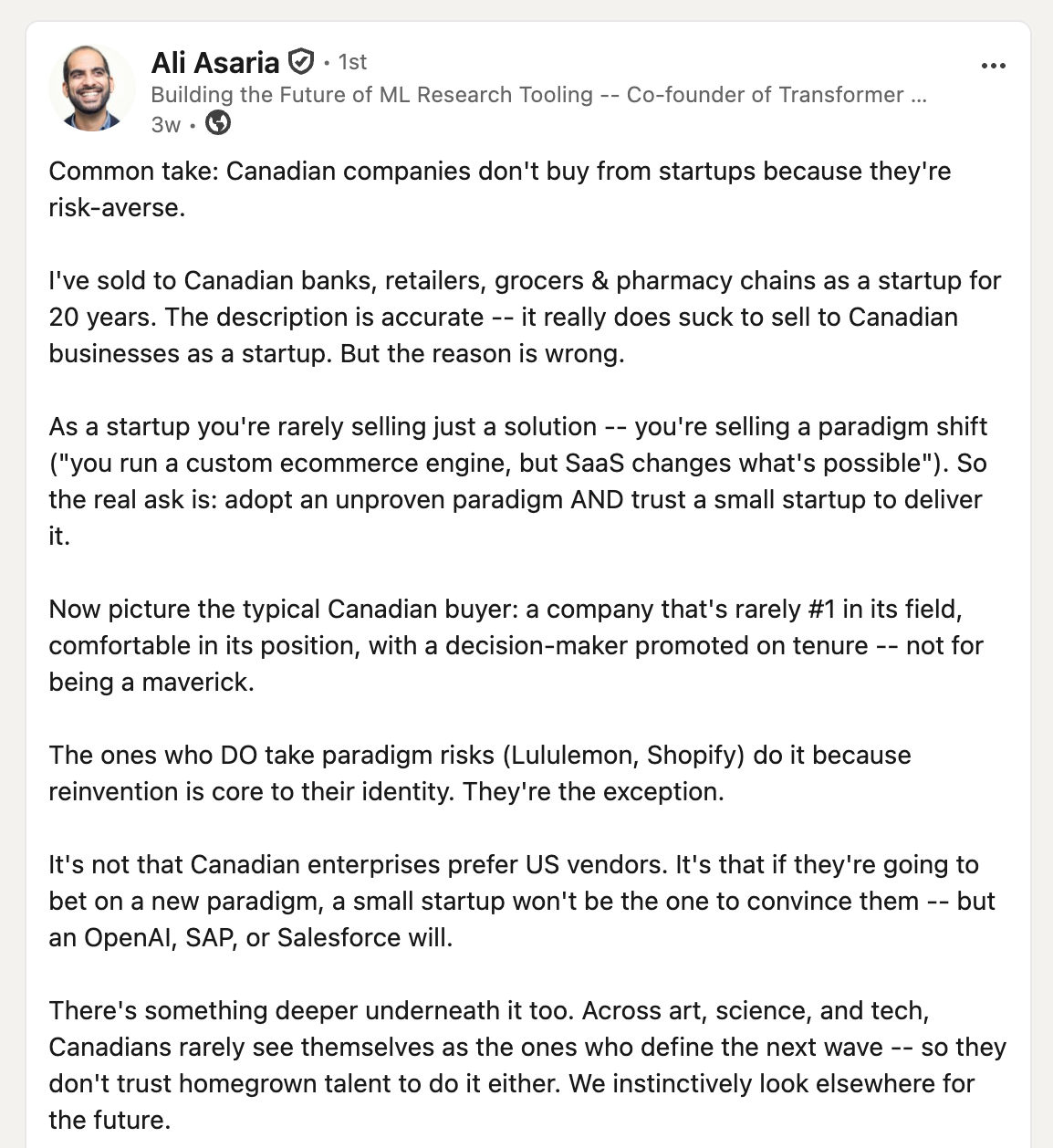
What he is describing is the home court disadvantage that Canadian founders have been talking about for years. It was one of the most repeated themes at Source Canada. In Asaria's words, “we instinctively look elsewhere for the future.”
If that is true then all the high profile projects underway to build a stronger Canada are unlikely to succeed.
So we asked Ali to share something constructive that Canadian corporate buyers can do. This was his response:
Taking a chance on a startup isn't charity, and it doesn't have to expose you — you hold the leverage. The startup wants your logo more than you need them, so open the door, then make big demands: put their team in your office, demand first call on their roadmap, set payment terms that make it reversible. That's what US companies do — they open the door, but they make you earn it.
For my last company, Tulip, our first big customer was the Canadian arm of a famous retailer and they asked us to do something for 1/20th the price of what any other enterprise software company would ask for – we did so happily, and that contract was the springboard for what became a very large enterprise business.
It's a refreshing take that dares large Canadian companies to open the door and be demanding. Create a path to earning a yes instead of defaulting to no.
Highlighted Deals
- Bell, Cohere, Hypertec and BUZZ HPC strike a $220M sovereign-AI compute deal. CBC News, Jun 18. BUZZ HPC signed a three-year, roughly US$220-million GPU cloud contract to run NVIDIA GPUs on Canadian soil at Bell's Merritt, B.C. site, with Cohere operating its models on Canadian-built Hypertec hardware.
- NordSpace opens a rocket-factory headquarters in Markham. BetaKit, Jun 17. The Canadian launch startup opened a new Markham headquarters and manufacturing facility to build rockets domestically.
- Germany's Giesecke+Devrient opens an AI research presence at Mila. The Logic, Jun 16. The German security-technology firm is establishing a roughly 15-person research team at Quebec's Mila to develop new AI tools, drawing foreign R&D into a Canadian institution.
Capital stack
- Nuvei to acquire Payoneer for US$2.75B. The Canadian Press, Jun 15. Montreal-based Nuvei agreed to buy U.S. cross-border payments firm Payoneer in an all-cash deal, forming a platform expected to process more than US$500 billion in annual volume across 190-plus countries.
- MDA Space to acquire Blue Canyon Technologies for US$620M. SpaceQ, Jun 19. Brampton's MDA Space agreed to buy Colorado satellite-maker Blue Canyon from RTX, gaining a U.S. security clearance and adding about US$3.5 billion to its pipeline in defence space.
- JPMorgan extends its US$1.5T security-and-resilience initiative to Canada. The Globe and Mail, Jun 15. The bank is bringing its 10-year financing pledge to Canada, targeting defence, energy and critical minerals, and is helping establish a Canada-headquartered Defence, Security and Resilience Bank.
- Showpass to acquire campus-engagement platform Bounce. BetaKit, Jun 16. Calgary ticketing company Showpass is acquiring Bounce to expand into campus events and student engagement.
Defence
- 49North wins $3.7M from General Atomics for Canada's Guardian RPAS program. Newswire, Jun 15. 49North, a wholly owned Canadian subsidiary of MDA Space, will design and build a NATO-standard Coalition Shared Database for Canada's Remotely Piloted Aircraft System program at its Richmond, B.C. facility, with delivery by August 2027.
- Marconi lands the first Canadian contract under the EU's SAFE pact. CBC News, Jun 15. Montreal-based Marconi Technologies won a contract worth more than $10 million to supply Canadian-made tactical radios to Poland's military, partnering with Poland's Enamor, with deliveries running through 2030.
- BDC study: the defence ramp-up is creating a three-speed divide among SMEs. GlobeNewswire (BDC), Jun 18. A BDC study with The Icebreaker, based on 642 owners surveyed, finds many small firms still on the sidelines of the defence build-out, with half of those seeking financing expecting difficulty obtaining it.
Policy
- For this Alberta firm, "Buy Canadian" isn't working as advertised. The Logic, Jun 17. Calgary crisis-detection AI firm samdesk, whose customers include NATO and the Pentagon, says the federal Buy Canadian push has not produced any Canadian government contracts.
International
- France drops U.S. Palantir for domestic ChapsVision in a sovereignty push. The Guardian, Jun 16. France's DGSI will replace Palantir with French startup ChapsVision, citing a refusal to accept new strategic-technology dependencies; Germany's domestic intelligence agency made the same swap last month.