New Research On No Research

· By Raymond Luk · 5 min read

New Research On No Research

The Council of Canadian Academies released The State of Science, Technology, and Innovation in Canada, its 251-page flagship report last updated in 2018. It paints a gloomy, but familiar, picture of the Canadian economy: productivity and innovation keep dropping, and this is a decades-long trend, not a blip.


The State of Science, Technology, and Innovation in Canada 2025
Over the last 20 years, the CCA has carried out a series of assessments evaluating…

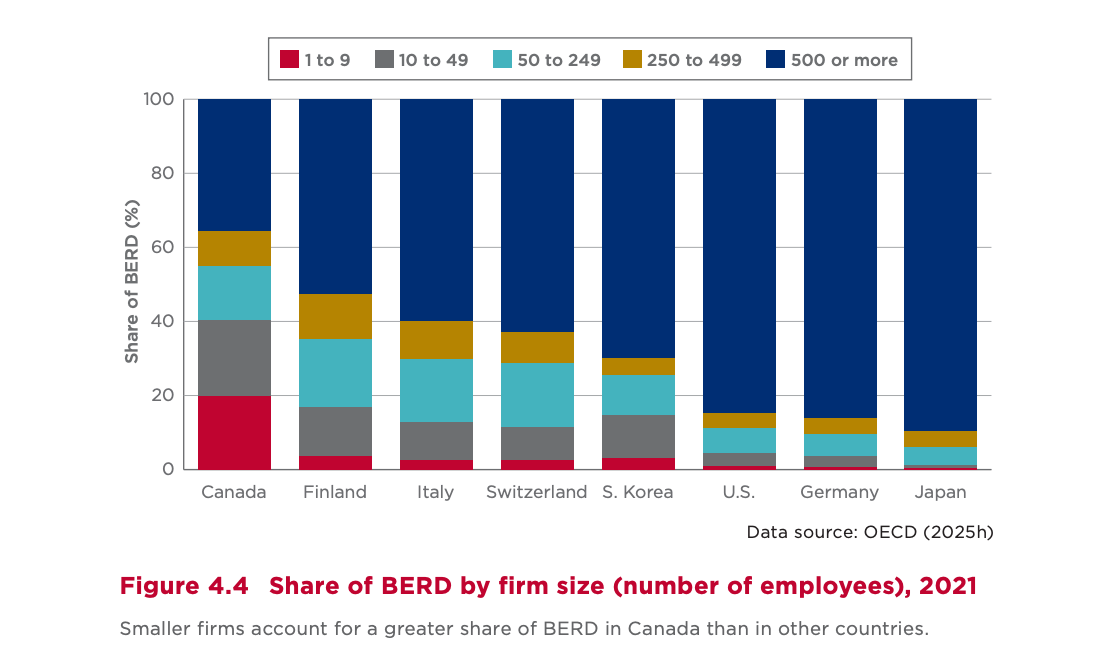
The above chart (page 78) shows business expenditures in research and development (BERD) broken out by firm size. The majority of R&D is being done by small firms, with only 36% of BERD by large enterprises (compared with 85% in the US). A self-fulfilling explanation is the relative lack of large firms in Canada.
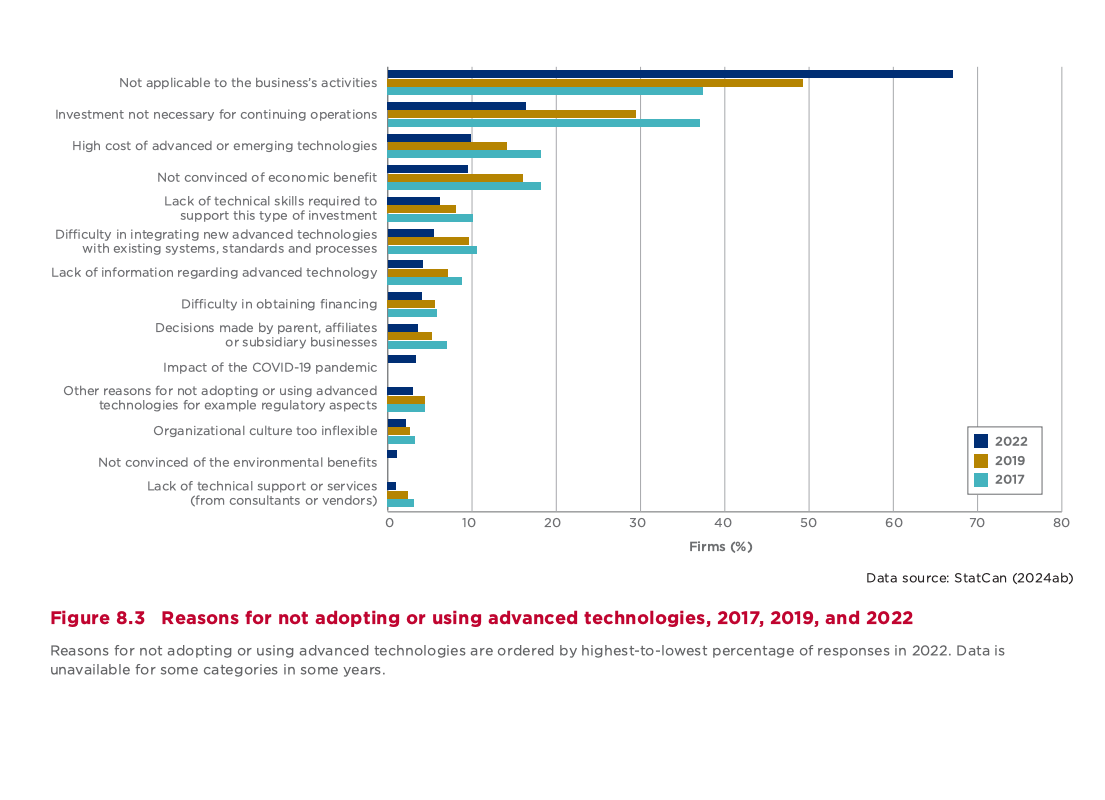
This chart (page 150) explains the snail's pace of technology adoption: the #1 reason for not adopting new technology, by a wide margin, was the feeling that it was “not applicable to the business's activities.”

This is not a good sign for rapid AI-adoption or rapidly doing anything in Canada. If business leaders think of innovation as “not applicable” then no amount of incentives will get them to move faster.

It reminds me of a conversation I had at Source Canada with a successful entrepreneur. He summarized the difference between selling to American vs Canadian corporations:

“The American buyer is looking at me as a source of competitive advantage, to get an edge over their rivals. They're rewarded for taking risks. In Canada it's the opposite. There's less competitive drive and they are penalized for risk-taking.”

Yet Another Buy Canadian Gap

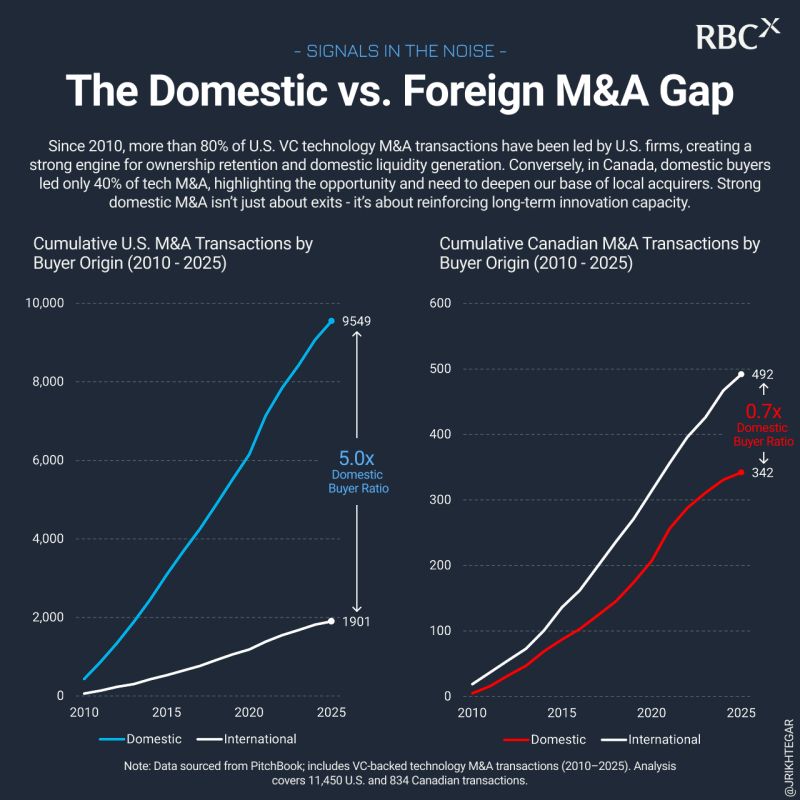
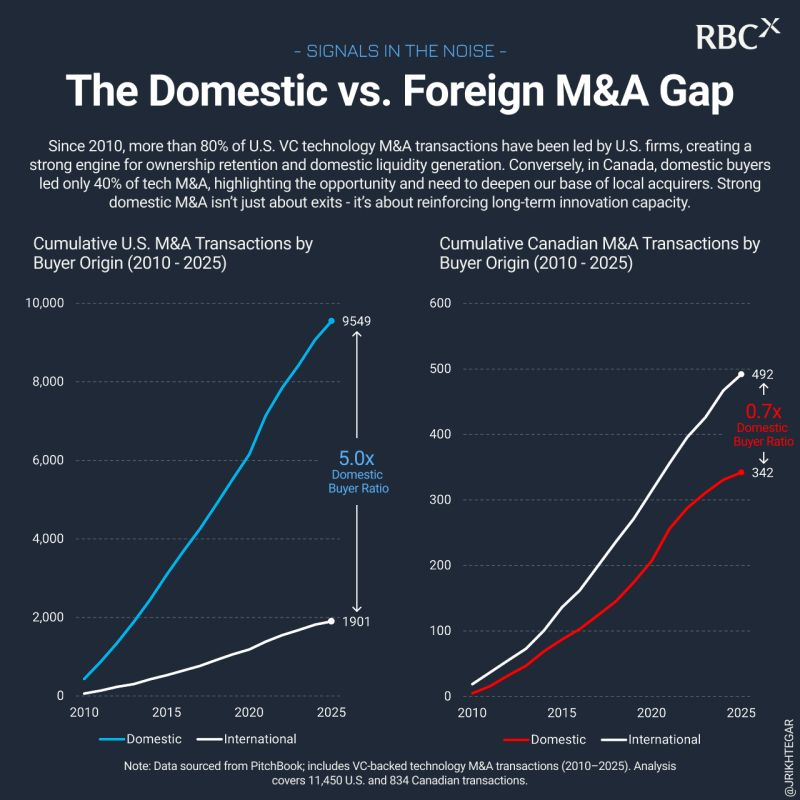
John Rikhtegar, from RBCx, posted this interesting comparison of who buys US vs Canadian startups. America buys 5X more US tech firms than they sell to international buyers. In Canada the radio is 0.7 (meaning foreign buyers buy more of our companies than we buy ourselves).

The advantages of Canadian firms acquiring Canadian startups is obvious: “When local firms acquire local companies, more of the long-term value - IP, talent, and reinvestment cycles - stays in-market. This is a foundational advantage of the U.S. ecosystem,” according to Rikhtegar.
U.S. vs. Canada: M&A Trends and Opportunities | John Rikhtegar posted on the topic | LinkedIn
𝐖𝐡𝐚𝐭 𝐡𝐚𝐩𝐩𝐞𝐧𝐬 𝐰𝐡𝐞𝐧 𝐭𝐰𝐨 𝐜𝐨𝐮𝐧𝐭𝐫𝐢𝐞𝐬 𝐛𝐮𝐢𝐥𝐝 𝐭𝐰𝐨 𝐯𝐞𝐫𝐲 𝐝𝐢𝐟𝐟𝐞𝐫𝐞𝐧𝐭 𝐌&𝐀 𝐞𝐜𝐨𝐬𝐲𝐬𝐭𝐞𝐦𝐬? Every ecosystem talks about the importance of exits. But not every ecosystem builds the same engine to deliver them. This week, I dug into 15 years of VC-backed technology M&A across the U.S. and Canada - not to compare scale, but to understand 𝐰𝐡𝐨 𝐢𝐬 𝐚𝐜𝐭𝐮𝐚𝐥𝐥𝐲 𝐛𝐮𝐲𝐢𝐧𝐠 our companies. To isolate that question, I charted cumulative M&A transactions (2010 - 2025) by buyer origin for both countries. The deal volume gap itself isn’t surprising: the U.S. has completed ~10.5x more deals and ~13.5x more M&A exits. The real story lies in where the buyers come from - and what that means for 𝐯𝐚𝐥𝐮𝐞 𝐜𝐫𝐞𝐚𝐭𝐢𝐨𝐧, 𝐥𝐢𝐪𝐮𝐢𝐝𝐢𝐭𝐲, 𝐚𝐧𝐝 𝐥𝐨𝐧𝐠-𝐭𝐞𝐫𝐦 𝐢𝐧𝐧𝐨𝐯𝐚𝐭𝐢𝐨𝐧 𝐟𝐥𝐲𝐰𝐡𝐞𝐞𝐥𝐬. In the U.S., over 11,000 M&A transactions have occurred since 2010 - and more than 80% were led by U.S. firms. That level of domestic acquisition activity keeps IP, talent, and strategic scale-ups rooted locally. It also creates a deep, predictable liquidity market for founders, employees, GPs and LPs - one that reinforces reinvestment and ownership retention. Canada’s pattern is different. Of the +800 Canadian VC-backed M&A transactions over the same period, ~40% were led by Canadian firms. U.S. acquirers alone represent nearly half (45%) of all Canadian exits. And interestingly, Canadian firms have acquired almost as many U.S. tech companies as Canadian ones (325 vs. 342). The ambition is there - now the challenge is scaling it toward homegrown innovation. 𝐊𝐞𝐲 𝐓𝐚𝐤𝐞𝐚𝐰𝐚𝐲𝐬 💡 1️⃣ 𝐃𝐨𝐦𝐞𝐬𝐭𝐢𝐜 𝐌&𝐀 𝐦𝐚𝐭𝐭𝐞𝐫𝐬...𝐚 𝐥𝐨𝐭: When local firms acquire local companies, more of the long-term value - IP, talent, and reinvestment cycles - stays in-market. This is a foundational advantage of the U.S. ecosystem. 2️⃣ 𝐂𝐚𝐧𝐚𝐝𝐚 𝐡𝐚𝐬 𝐚 𝐫𝐞𝐚𝐥 𝐨𝐩𝐩𝐨𝐫𝐭𝐮𝐧𝐢𝐭𝐲: At ~40% domestic-led exits, Canada isn’t “behind” - it’s under-scaled. The ambition exists (as shown by Canadian buyers’ activity in the U.S.), but mobilizing that same muscle at home would materially deepen our ownership base. 3️⃣ 𝐒𝐭𝐫𝐨𝐧𝐠 𝐝𝐨𝐦𝐞𝐬𝐭𝐢𝐜 𝐞𝐱𝐢𝐭𝐬 𝐬𝐭𝐚𝐛𝐢𝐥𝐢𝐳𝐞 𝐫𝐞𝐭𝐮𝐫𝐧𝐬: A deeper homegrown M&A market gives founders, employees, GPs and LPs more predictable liquidity pathways - reducing reliance on foreign buyers and smoothing return cycles for Canadian venture funds. 4️⃣ 𝐈𝐧𝐬𝐭𝐢𝐭𝐮𝐭𝐢𝐨𝐧𝐬 𝐡𝐚𝐯𝐞 𝐚 𝐫𝐨𝐥𝐞 𝐭𝐨 𝐩𝐥𝐚𝐲: Public and private players can help build the domestic buyer base by supporting local acquirers and creating the conditions for Canadian companies to scale into natural buyers themselves. The message isn’t that Canada is behind - it’s that we have a clear opportunity. Strengthening domestic M&A is one of the most direct ways to retain ownership, recycle liquidity locally, and scale the next generation of Canadian champions. 𝐒𝐢𝐠𝐧𝐚𝐥𝐬 𝐢𝐧 𝐭𝐡𝐞 𝐍𝐨𝐢𝐬𝐞 🤓

Buy Ontario Please! 

Ontario tabled its Buy Ontario Act, 2025 currently making its way through the legislature. The idea is to compel Ontario government organizations to prefer Ontario-based, then Canadian-based, firms over foreign entities.

This makes sense but, as one government organization told me, this is all performative unless there are additional funds to pay for switching costs, eg from a US-tech solution to a Canadian one. Not to mention funds to defend trade actions and lawsuits.

Buying Ontarian (and Canadian) is an essential boost of domestic vs foreign-owned technology firms. But there will be costs associated with finding, qualifying and switching to domestic firms.


Buy Ontario Act, 2025
Bill 72 from Parliament 44 Session 1 of the Legislative Assembly of Ontario: Buy Ontario Act, 2025.

If you have news, insights or tips about using procurement to drive innovation in Canada, just reply to this email or add a comment below.

Updated on Nov 24, 2025